| Top 10 Global Pet Food Companies in 2025 |
| Release time:2026-09-09 15:37:28| Views: |
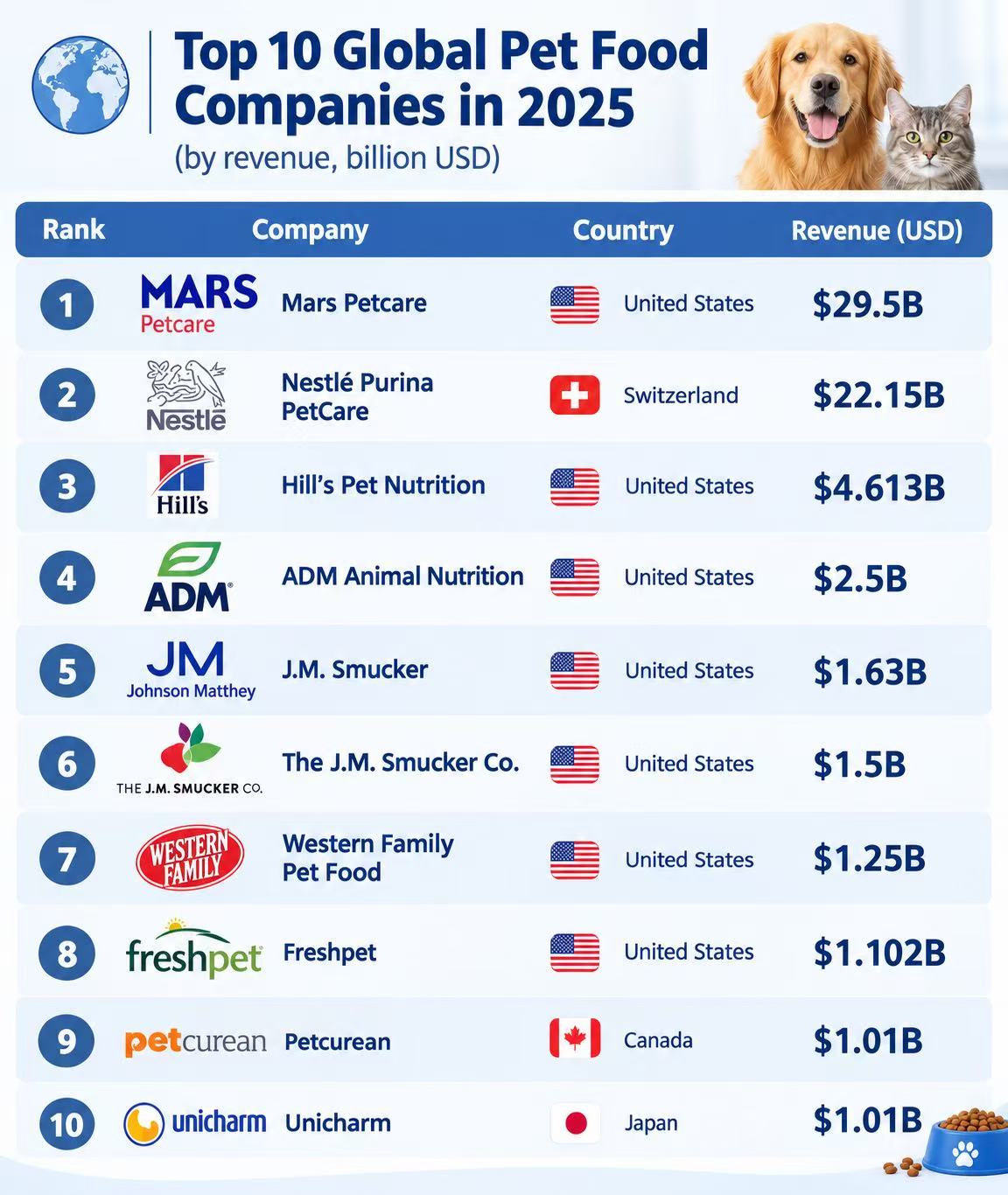
Top 10 Global Pet Food Companies in 2025 Recently, Petfood Industry released its 2025 ranking of the world’s leading pet food companies by revenue. The annual ranking is widely regarded as an important indicator of industry trends and market dynamics. This year’s global Top 10 saw several notable changes, while the Asian market also showed new developments. Here are the key rankings and trends. Global Top 10: Mars Returns to the Top The biggest change in this year’s global ranking is the return of Mars Petcare to the No. 1 position, with annual revenue of US$29.5 billion. After ranking second last year, Mars benefited from the integration and acquisition of premium pet food brands, including ORIJEN and ACANA, which contributed significantly to its overall growth. Nestlé Purina PetCare ranked second with revenue of US$22.15 billion. Although its revenue declined slightly compared with the previous year, Nestlé Purina remains one of the largest players in the global pet food market. Hill’s Pet Nutrition ranked third with revenue of US$4.613 billion, continuing to strengthen its position in prescription diets and clinical nutrition. General Mills ranked fourth with revenue of US$2.5 billion, supported by its focus on natural and functional pet food products. One of the biggest movers this year was Belgium-based United Petfood, which ranked fifth with revenue of US$1.7 billion, up from seventh place last year. The company focuses primarily on private-label and customized pet food manufacturing. Its growth reflects the increasing importance of private-label pet food in the retail market. The remaining companies in the global Top 10 were J.M. Smucker with US$1.63 billion, Diamond Pet Foods with US$1.5 billion, Simmons Pet Food with US$1.25 billion, Freshpet with US$1.102 billion, and Japan’s Unicharm with US$1.01 billion. Unicharm was the only Asian company to enter the global Top 10. Overall, the global ranking remains heavily dominated by European and North American companies. Mars and Nestlé Purina maintain a significant lead in revenue, while the gap between these two global giants and the rest of the market remains substantial.
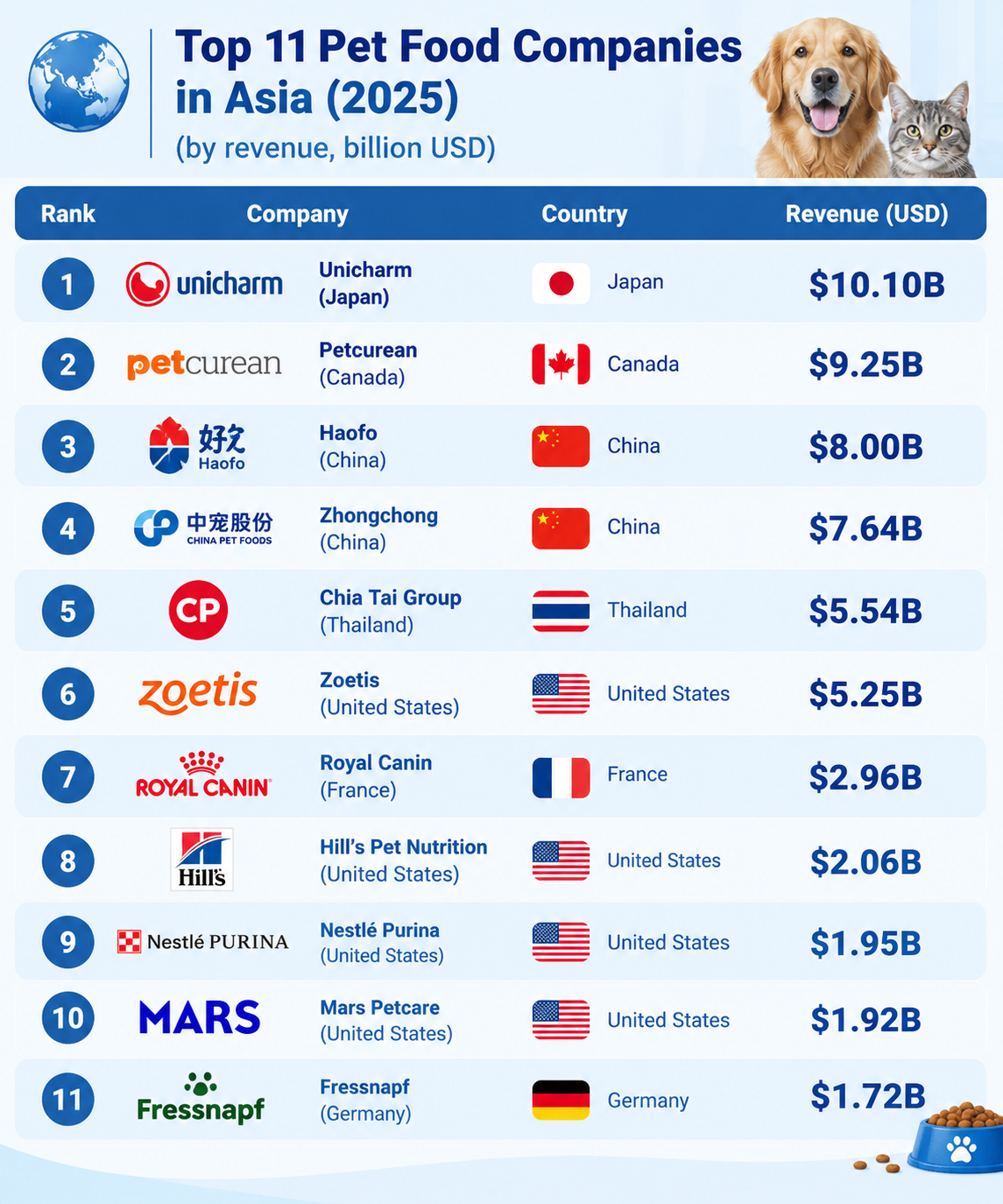
Asian Top 10: Japan Leads, China Follows Closely In Asia, Japanese companies continue to lead the regional pet food market. Japan’s Unicharm ranked first in Asia with revenue of US$1.01 billion, followed by Inaba with US$925 million, giving Japan the top two positions. Thailand’s Haofo ranked third with US$800 million. China’s China Pet Foods (Zhongchong) ranked fourth with US$764 million, while Guaibao Pet ranked fifth with US$720 million. Thai Union Seafood ranked sixth with US$554 million, followed by South Korea’s First Feed with US$525 million. Lide Pet Food from Türkiye and the Philippines’ Universal Robina both recorded approximately US$200 million, sharing eighth place. Japan’s Petline ranked tenth with US$190 million. The Asian Top 10 is relatively diverse. Japan accounts for three companies, China and Thailand each have two, while South Korea, Türkiye, and the Philippines each have one. Japanese companies benefit from advanced processing capabilities and established brand equity. Thailand has competitive advantages in marine-based ingredients and export-oriented manufacturing, while China benefits from its integrated supply chain, large-scale manufacturing capacity, and rapidly growing domestic pet market.
What Do These Rankings Tell Us? Looking at the global and Asian rankings together, we can see two different competitive dynamics. Global pet food leaders are competing primarily through brand strength, premium positioning, R&D capabilities, and product innovation. Many Asian companies, meanwhile, continue to compete through manufacturing scale, supply chain efficiency, cost competitiveness, and access to growing regional markets. The rise of companies such as United Petfood also highlights the growing importance of private-label and contract manufacturing in the global pet food industry. For pet food manufacturers and brands looking to enter or expand in the Asian market, these trends are worth watching closely—not only from a market perspective, but also from the perspective of regulatory compliance, product registration, and market access. Source: Petfood Industry |
How to Export Food, Pet Food, Feed and Feed Additives to China? Immediately evaluate